
Level 1 is where most campaigns begin, and it is also where they are most likely to end by accident. Characters have very few hit points, so a single bad round can remove half the party. The good news is that early levels are also the easiest to run well, because the stakes are small and the story has room to grow.
This guide covers levels 1 to 4. After that, most characters have enough resources that the game starts to feel different, and you can move on to something like the level 3 to 5 one-shot guide.
Why level 1 is dangerous
A level 1 character has roughly six to fourteen hit points, depending on class. A goblin's scimitar can do up to eight damage on a good hit, and monsters often come in groups. Even a handful of weak enemies can overwhelm a party that is not ready for them.
That is not a reason to avoid fights. It is a reason to design them carefully, give players options other than fighting, and make sure a defeat does not end the story.
Size fights for the party you have
The Dungeon Master's Guide has encounter-building rules based on experience points, and they are worth a look. One result surprises many new Dungeon Masters: by the 2014 version of that math, four goblins against four level 1 characters sits at the edge of a deadly encounter. Goblins are the classic beginner monster, and four of them are not a gentle warm-up.
A few habits keep fights fair:
- Start with fewer enemies than players. Two or three enemies for a party of four is a good first fight.
- Give the party a weak opening fight, so they learn the rules while the stakes are low.
- Let enemies run or surrender. A goblin who flees when its friends fall is more realistic, and it shortens the fight.
- Telegraph the dangerous one. If a big creature is in the next room, let the players hear or see it before they open the door.
Level up quickly
In the standard experience-point system, characters reach level 2 at 300 XP, level 3 at 900, and level 4 at 2,700. Many tables skip the counting and simply level the party at natural story milestones. Either works. What matters is that you do not make players wait: levels 1 and 2 pass quickly, and a new ability early is one of the best rewards you can give.
A common plan is to give the party level 2 after the first session or two, and level 3 shortly afterward. Level 3 is when most classes pick a subclass, so it is a good moment for a first real choice.
Build the first adventure around three beats
For a first adventure, you do not need a large dungeon. Use the same three beats as a one-shot: an opening scene that sets the tone, a complication that changes what the party thinks is going on, and a finale where the villain, the place, and the party's choices come together.
- The hook. Give the party a clear, urgent problem, like a missing caravan or a mine about to collapse. Vague quests are harder for new players.
- A home base. One small town, with three or four named people, is enough. Returning to a place with familiar faces makes a campaign feel real.
- Clues in more than one place. New groups miss things. If the only clue is behind one door, put a second copy somewhere else.
- Ways to win that are not combat. Talking, sneaking, and clever ideas should all be on the table.
Let the party recover
At low level, characters run out of resources quickly, so rests matter. A short rest takes an hour and lets characters spend hit dice to heal. A long rest takes about eight hours and restores most of what they have lost. Tell the players early that they can rest, and make sure the story allows for it. A party that never gets a chance to recover will play too cautiously or end up in a fight at half strength.
If you want a little pressure, use a visible clock, such as a ritual that finishes at dawn, so resting costs something. Visible Trackers has ways to do that.
Plan for a character dying
Sometimes the dice are cruel. Decide before the game how you will handle it, and tell the table. Some Dungeon Masters let a new character join in the next scene. Some give a downed character one more chance. The important thing is that nobody sits out the rest of the evening, because that is how new players stop coming back. For help setting expectations, see the session zero checklist.
Use short, ready-made encounters
You do not have to write everything. Some of the free encounters on this site are built for low levels and run in 30 to 45 minutes: The Mushroom King's Stolen Crown (levels 1 to 5), The Exploding Fuse Room (levels 2 to 5), and Dinner at the Hungry House (levels 2 to 5). Trick or Tithe works from level 1 up to level 8.
When your players are ready for a full evening, Goblins GO BOOM and The Huntsman's Game are both written for levels 3 to 5.
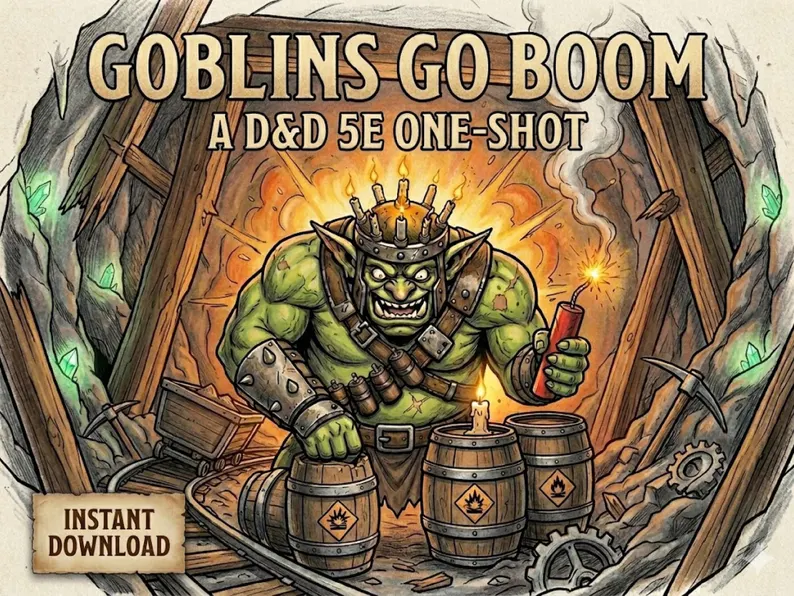
Goblins GO BOOM
A levels 3-5 demolition dungeon with a Chaos tracker, four routes into the mine, a two-phase finale with a five-round collapse, and maps and tokens included.
An early-level checklist
- Open with a clear, urgent problem and a small home base.
- Run a first fight with fewer enemies than players.
- Check encounter size before the session, using the Dungeon Master's Guide.
- Level up after the first session or two.
- Let enemies flee or surrender.
- Make sure the party can rest.
- Decide what happens if a character dies, and tell the table.