
Experienced Dungeon Masters already know how to build tension in their heads. The trouble is that tension in your head is invisible. Players cannot weigh a risk they cannot see, so they either play too carefully or too carelessly.
A visible tracker fixes that. It is a number on an index card that goes up and down based on what the table does, and it tells everyone what is at stake.
Why visible beats hidden
When the pressure is secret, you are the only one who knows how close things are to going wrong, and every consequence feels like your decision. When it is visible, the players make the choice, and the result feels earned. A party that sees the number at two out of three will argue about whether to risk it, and that argument is the game.
Five trackers from adventures I have published
These are my own designs, so I can describe exactly what they do and what I learned from each.
1. Chaos, from Goblins GO BOOM
Every major disturbance marks one Chaos: a loud fight, a failed sneak attempt, casting magic near the unstable crystals. At three Chaos, something goes wrong. The finale adds a second clock, a tracked five-round chamber collapse.
The lesson: tie the number to what players do, not to the passage of time. They can see how their choices feed it.
2. Trail, from The Huntsman's Game
Trail runs from zero to three and measures how close the Huntsman's pack is to finding the party. Crossing water, hiding in the canopy, and leaving blood behind all move it. A printable tracker sits at the table.
The lesson: make it go both ways. Careless play raises it, and clever play lowers it, so the party can always recover and never feels doomed.
3. Doubt and Trust, from The Pale Jester's Theatre
The adventure tracks Doubt and Trust while an Archfey stages illusions designed to make party members misread each other. A DM cheat sheet keeps both tracks and the Jester's rules visible.
The lesson: a tracker can measure a relationship instead of an enemy, which makes a social scene as tense as a chase.
4. Victory Marks, from The Grand Carnage
The party earns a Victory Mark for each tournament trial it clears. A failed trial costs something instead of ending the run, and what the party does with its rivals shapes the ending.
The lesson: use a number that records progress, and make failure cost something rather than stop the story.
5. Crowd Favor, from The Undercard
A free arena encounter on this site tracks Crowd Favor from zero to five, starting at two. Daring flourishes raise it, stalling lowers it, and the final total decides what the party earns.
The lesson: a mood meter rewards style and discourages stalling without a single extra rule.
Rules for building your own
- Keep the scale small. Zero to three or zero to five. Bigger scales invite arithmetic.
- Make it move both ways. Players should be able to push it down as well as up.
- Say exactly what moves it. If players cannot predict the effect of an action, the tracker is just another secret.
- Decide what happens at the top. The consequence should be a change in the situation, such as reinforcements arriving or the floor giving way, and not a flat penalty.
- Use one tracker per scene. Two can work if they measure different things, but three is a spreadsheet.
- Keep it where everyone can see it. An index card, a dry-erase board, or a few tokens will all do.
A template
One-line tracker
Name: ___ | Scale: 0 to ___ | Raises when: ___ | Lowers when: ___ | At the top: ___ | At zero: ___
Fill in each blank before the session. If you cannot fill in one of them, the tracker is not ready.
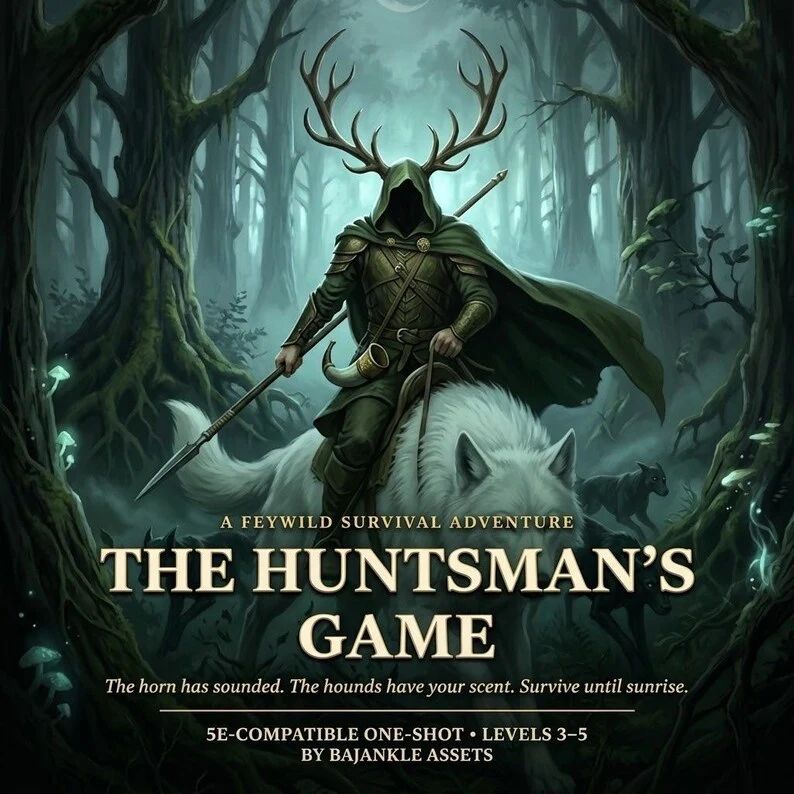
The Huntsman's Game
A 21-page, levels 3-5 Feywild one-shot built around Trail, a 0-to-3 scale that tracks how close the pack is. It runs 3 to 5 hours and includes a printable DM Hunt Tracker.