
Treat the Feywild like a regular forest with nicer lighting and it gets boring fast.
The Fey feel dangerous when the rules of the place only make sense after someone's already broken one. A good encounter goes after certainty itself: a name, a promise, a memory, what a perfectly ordinary sentence actually meant.
Give the location one impossible rule
Skip the random tables. Pick one rule and repeat it until the players start planning around it.
- Every lie creates a physical object somewhere nearby.
- Names spoken aloud can be taken.
- Applause makes the scene more real; silence weakens it.
- The path follows whoever is most afraid, not whoever is leading.
- A promise is binding even if the speaker meant it sarcastically.
Once players catch on, the fun is using the rule. Not guessing what you're thinking.
Give the antagonist something to prove
Fey villains are more memorable when the party is evidence in an argument. An Archfey might want to prove that friendship is performative, that mortals always break promises, or that fear is stronger than love.
That's a better scene generator than “evil creature wants to kill you.” Let the antagonist offer bargains, plant false evidence, or reward betrayal. Anything that gives the party a real shot at proving the premise wrong.
Use beauty and danger at the same time
A white-barked grove full of silent bells is more unsettling than a pile of skulls if the players do not know what rings them. A banquet is more Fey when every dish looks perfect but the host refuses to say what accepting food means.
The visual should attract the players while the rule makes them hesitate.
Fey bargain rule
Make the cost legible before it becomes permanent. Wordplay is fun; gotcha-contracts are not. Give players enough information to realize there is danger, then reward careful wording.
Attack relationships without removing player agency
Illusion doubles of party members, private messages, conflicting evidence, and selective memories already create plenty of tension on their own. Just don't tell a player what their character secretly believes, and never force a betrayal. Put the suspicious evidence on the table and let them decide if they trust it.
End with a choice that answers the theme
A trust-themed adventure needs a finale that actually requires trust. If bargains are the throughline, winning should come down to wording one correctly. Identity-themed games work best when the last scene forces someone to decide which name, or which memory, actually matters.
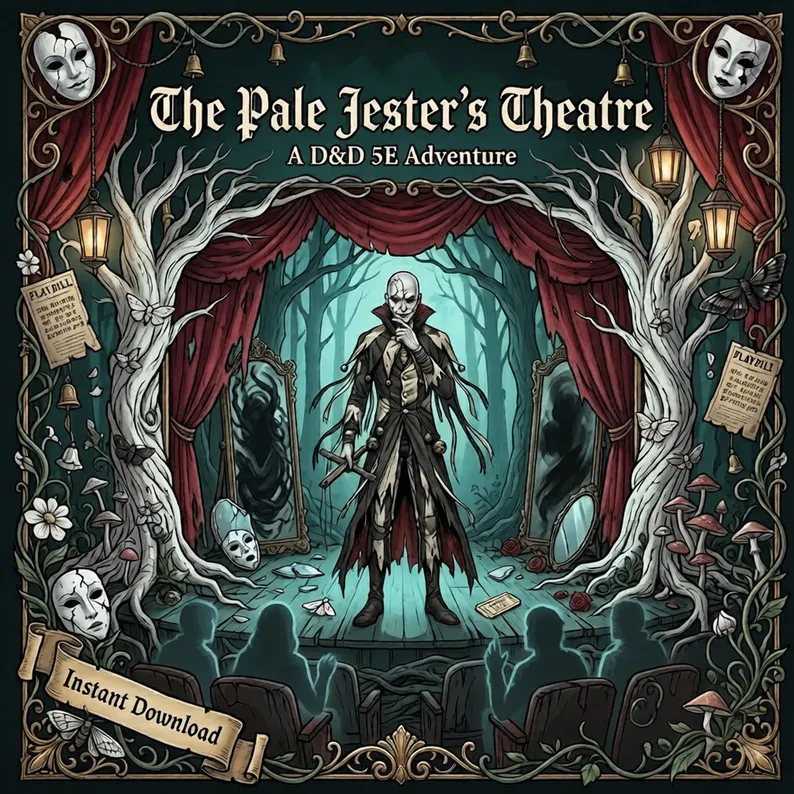
The Pale Jester’s Theatre
An Archfey builds a theatre around the party and tries to prove that trust is only an act that collapses under pressure.
View on Etsy ↗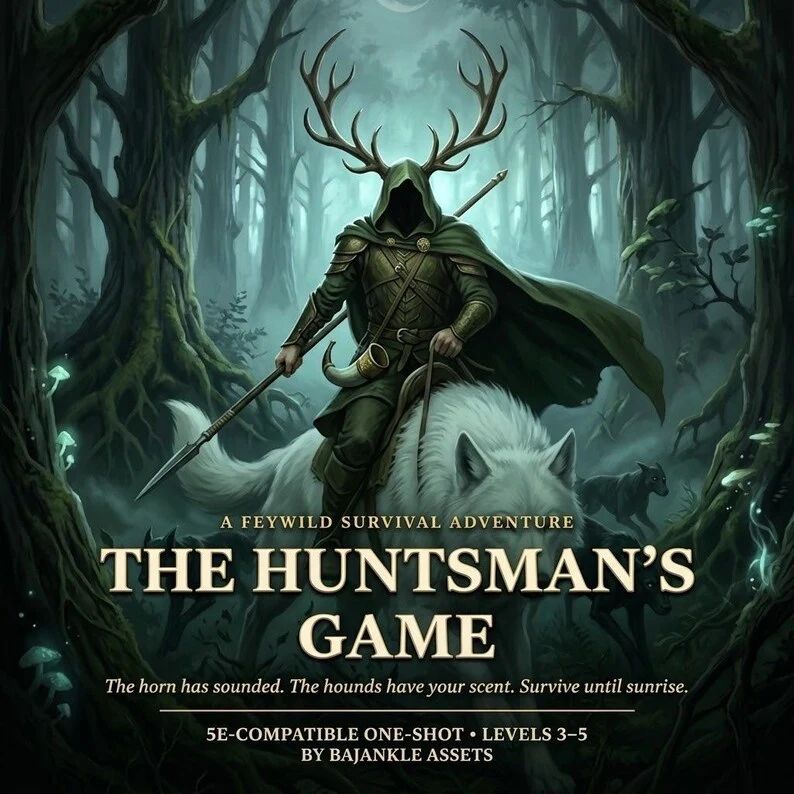
The Huntsman's Game
The Hunt Without Prey, expanded into a full one-shot: the party is quarry in an ancient Fey hunt, with one rule that matters more than any other: survive until dawn.
View on Etsy ↗Want to see the tone in action before you commit to a full adventure? The Mushroom King's Stolen Crown is a free, complete Feywild encounter you can run tonight.
Five quick Fey encounter seeds
- The Unfinished Toast. A feast can't end until every guest sincerely praises someone they distrust.
- The Borrowed Shadow. A sprite offers safe passage. The price is one character's shadow, returned at sunrise. Probably.
- The Path That Hears. Talk about where you're going and the path moves farther away.
- The Moth Court. Every moth drifting through the scene is carrying a fragment of somebody's memory.
- The Hunt Without Prey. As far as the party knows, nobody's hunting anything. They're wrong, and the only way to win is to survive until dawn.
If your Fey adventure involves characters doubting each other, read Running In-Character Distrust Safely and the session zero checklist first.