
When a villain tries to turn the party against itself, the fun comes from characters doubting each other while the players enjoy the show. It goes bad when the doubt leaks out of the story and the players start doubting each other.
These steps are written for experienced Dungeon Masters. The mechanics are simple, and most of the work is care.
Ask first
Not every table wants this. Before you run it, have a short conversation: "In this adventure, a villain will make your characters doubt each other. You might see an ally act strangely or be shown something that looks bad. It is all in-character, and anyone can pause the game at any time. Is this something you want?"
If anyone hesitates, take it seriously. You can run a lighter version, or something else entirely. A session zero that includes lines, veils, and a pause option is a good place for this conversation, and a session zero checklist can help.
Play fair with the rules of the trick
Players accept being fooled when they can see, afterward, that they had a chance. Give the manipulator rules and stick to them. The Pale Jester in The Pale Jester's Theatre never directly lies, and every illusion he builds must leave a flaw. Players who figure that out can use it. That is the difference between feeling cheated and feeling outwitted.
Whatever the villain's rules are, make them discoverable. Clues should exist, and a careful party should be able to tell the difference between a real ally and a trick.
Keep it between the characters
Remind the table, before and during, that the distrust belongs to the characters. A few habits help:
- Describe illusions in the open, so every player knows what is happening to the group.
- Avoid secret notes that make one player privately suspicious of another. If you use secrets, agree on them beforehand.
- Do not use effects that take away a player's choices. Doubt and misdirection are fine, but making someone do something is a different game.
- Let players speak out of character when they want to. "My character is suspicious, but I'm having a great time" is a good sign.
Track it where everyone can see
A visible tracker gives distrust a shape and a ceiling. The Pale Jester's Theatre tracks Doubt and Trust on a DM cheat sheet, so the table knows how deep the damage is. Seeing the numbers also reminds everyone it is a game mechanic, not a verdict on anyone at the table. For more on this kind of device, see Visible Trackers: Five Ways to Add Pressure.
Time-box it
Distrust gets uncomfortable when it drags. Plan a beginning, a peak, and a release. A single session, or a defined stretch, is better than weeks of low-level suspicion. If you see energy dropping or anyone looking uneasy, move to the resolution.
Give them a way out
Characters need a way to resolve the doubt. That might be a test, a piece of evidence, a witness, or a moment where an ally proves themselves. Plan this before you start. A trick with no solution is just a punishment.
Check in afterward
When the scene is over, step out of character. Ask how it felt and whether anyone wants a different approach next time. A short check-in turns a risky scene into a shared story, and it tells you what your table can handle.
A short checklist
- Get consent beforehand, and name the pause option.
- Give the manipulator fair, discoverable rules.
- Describe illusions openly.
- Do not remove player choices.
- Track the doubt where everyone can see it.
- Plan the release before you start.
- Check in afterward.
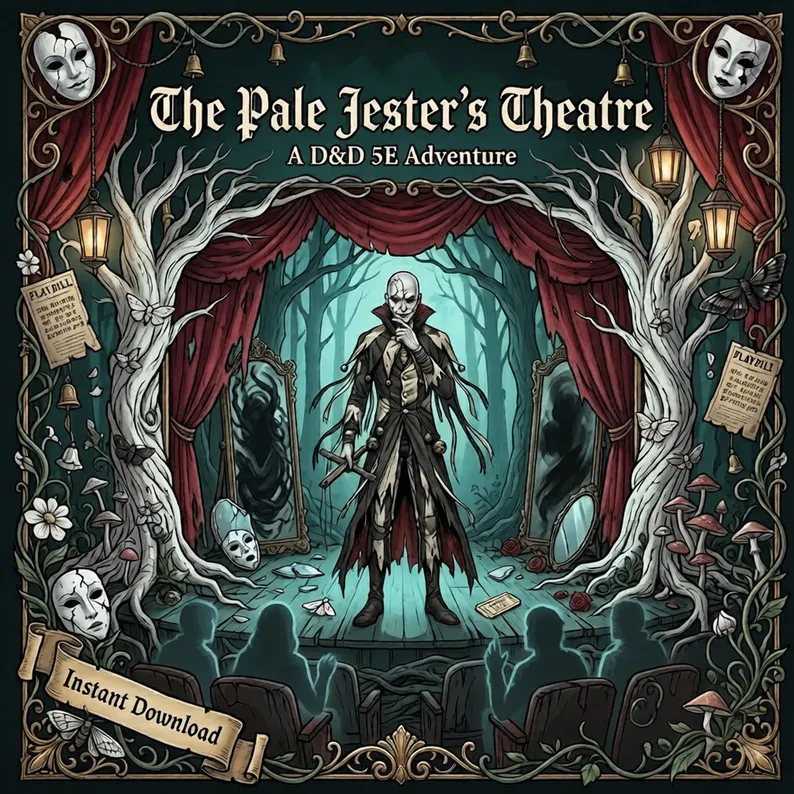
The Pale Jester's Theatre
A levels 5-8 Feywild adventure where an Archfey stages illusions to make the party misread each other. It includes tracked Doubt and Trust, a DM cheat sheet, and built-in Session Zero and safety-tool guidance.