
Most tavern NPCs are a name, a hair color, and a plot hook. They work for one conversation. Players remember the ones who feel like they have somewhere to be.
The method below comes from The Common Accord, where seven tavern staff are each written with the same five parts. It works for any NPC the party will talk to more than once.
The five parts
- A public role. What everyone thinks they do. The cook, the stable hand, the innkeeper.
- A secret role. What they actually do. The cook is an informant. The stable hand is watching the road.
- A private motive. Why. Debt, loyalty, fear, ambition.
- A moral compromise. Something they have already done that they are not proud of.
- A line they will not cross. The one thing they will refuse to do, even under pressure.
Why the line matters most
The first four parts tell you about the NPC. The fifth tells you what to do when players push. A character with a secret and no limit will do anything, which makes them unreadable. A character with a line has a shape the players can find.
It also gives you a quick answer when you do not know what an NPC would do. If a player threatens them, does that cross the line? If not, they will probably bend. If so, they will resist. You can decide in two seconds, and it will feel consistent.
An example
Odette, the cook at a mountain inn
Public role: cook. Secret role: passes word to smugglers about who is staying. Private motive: her brother owes them money. Compromise: she once let a guest take the blame for a theft she knew he did not commit. Line: she will not let anyone be poisoned.
Now see how it plays. A party that befriends Odette gets a warm kitchen and a free meal, but not the truth. A party that catches her passing a note can pressure her about her brother, and she will give them something. But if they ask her to put a sleeping draught in the wrong guest's stew, she will not, whatever they offer. They have found her line, and the scene changes.
Let the players find it
Do not announce secrets. Plant three clues for each, in different places, so that a clever party can put it together even if they miss one. The first clue should be easy, and the others progressively harder.
Clues should come from behavior: the cook's hands shake when a certain guest arrives, the stable hand keeps a lantern lit past midnight. Players who notice are rewarded.
Reward suspicion, do not punish it
When players dig, give them something. In The Common Accord, suspicious or clever play is rewarded with a weaker tribunal, not punished. The same principle applies to any investigation. If the party figures out an NPC's secret early, let them use it. Players who feel clever will keep investigating, and ones who feel punished will stop.
Keep it to the NPCs who matter
You do not need this for every character. The innkeeper, the rival, the contact, and the patron are worth it. The villager who sells apples is not. Five or six well-built NPCs will carry a session better than twenty thin ones.
A quick template
- Public role: ___
- Secret role: ___
- Private motive: ___
- Moral compromise: ___
- The line they will not cross: ___
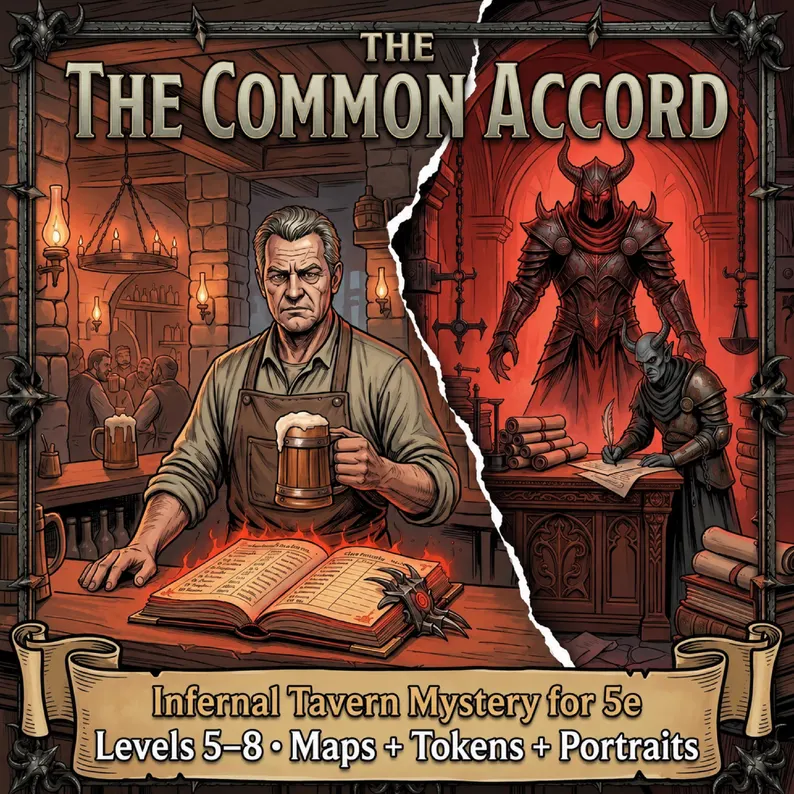
The Common Accord
A 35-page infernal tavern mystery with seven fully written NPCs, each with a public role, a secret, and a line they will not cross. Maps, tokens, and portraits are included.