What a tabletop roleplaying game is
A tabletop roleplaying game is a story told out loud, where each player decides what their character does and the outcome changes the story. There's no screen and no board to set up. Just a person guiding the story (the Game Master) and one or more players making choices.
How a child participates
A young player picks a simple hero, hears the situation described, and chooses what to do next: which path to take, who to talk to, what to count or compare. Choices are kept physical and visible wherever possible: pointing at something, moving a token, counting objects on the table, instead of asking a small child to track abstract rules in their head.
How the simplified system works
These adventures skip the parts of D&D-style play that don't help a 3–7-year-old: no initiative order, no ability score math, no long character options list. A character can be represented by a name, a picture, a few hearts, and one or two strengths. If your child can glance at it and say who their hero is, it's doing its job.
Do you need to read?
No. An adult (or older sibling) reads the story aloud and asks the questions; the young player answers, counts, points, and decides. Read-aloud text and DM-only guidance are printed separately in each adventure, so you always know what to say out loud.
What the parent or guide does
You read the situation, offer choices when your child looks stuck, and let their answer actually change what happens next. You're not steering toward the “correct” choice. Run a companion character, ask questions, and celebrate ideas while your child stays the one making decisions.
Session length
The Kingdom of Numeria chapters run 60–90 minutes each, or up to about 2 hours if you play every optional scene. For younger or more restless players, each chapter is written to split cleanly at a scene break rather than mid-story, so one adventure can become two or three shorter sessions.
What you'll need
An adult to read and guide, one or more kids, and whatever the specific listing calls for (some material may be printable; check the individual product page for details). No board, miniatures, or separate rulebook purchase is required to get started.
Storytelling, teamwork & learning, built into the story
Counting, comparing, and sequencing stand between the hero and the next scene, instead of showing up as a worksheet stapled to the adventure. Counting three missing lanterns opens a gate; comparing two piles decides who gets the bigger slice; putting numbers back in order reveals a path. The child solves the problem because their hero needs the answer, not because story time stopped for math time.
Which adventure to play first
Start with The Missing Three, Chapter 1 of the Kingdom of Numeria series. It's the lowest-friction entry point and sets up the world the later chapters build on. Not sure it's a fit yet? Try The Bridge of Three Lanterns first, a free 15–20 minute prologue scene that leads directly into Chapter 1.
How the Kingdom of Numeria series progresses
Every chapter starts in Countingbrook, the kingdom's home village, and sends the party's Number Knights out to fix whatever's gone missing from the Great Equation, ten glowing crystals numbered 1 to 10. A recurring villain, the mysterious Null King, sits behind the trouble across all three chapters. Characters carry over from one chapter to the next if your group wants to keep the same heroes.
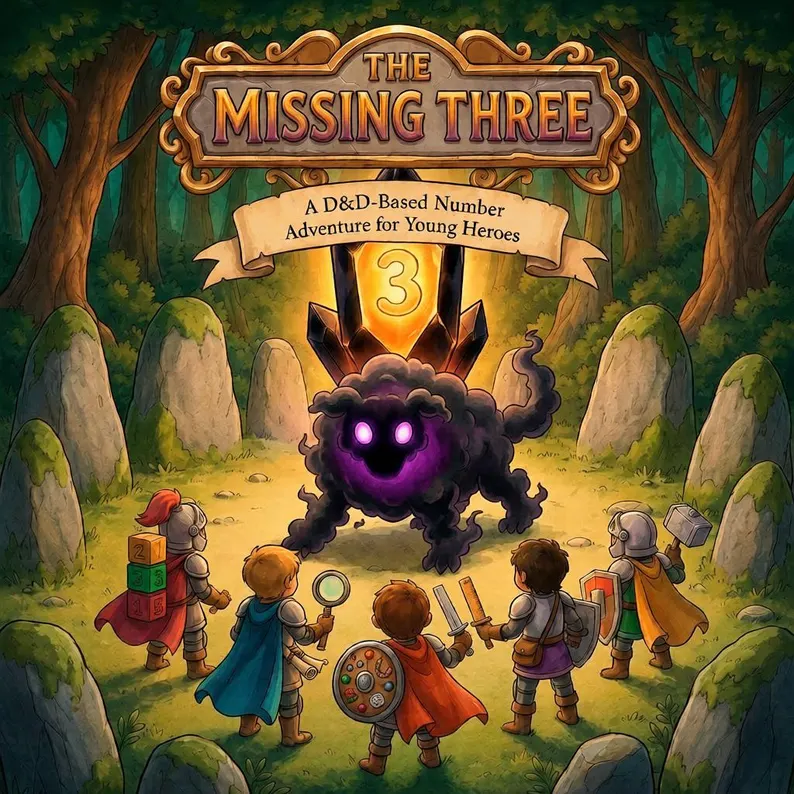
The Missing Three
Counting and number recognition, as the Number Three vanishes from the world. See the product page →
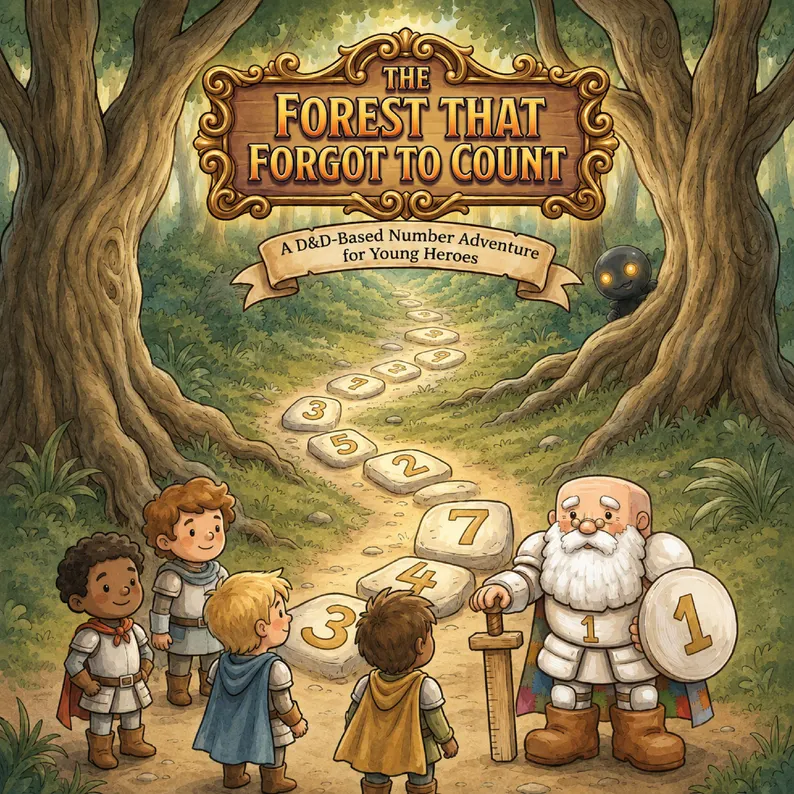
The Forest That Forgot to Count
Number order and sequencing, as a shadow creature scrambles the Numberwood. See the product page →
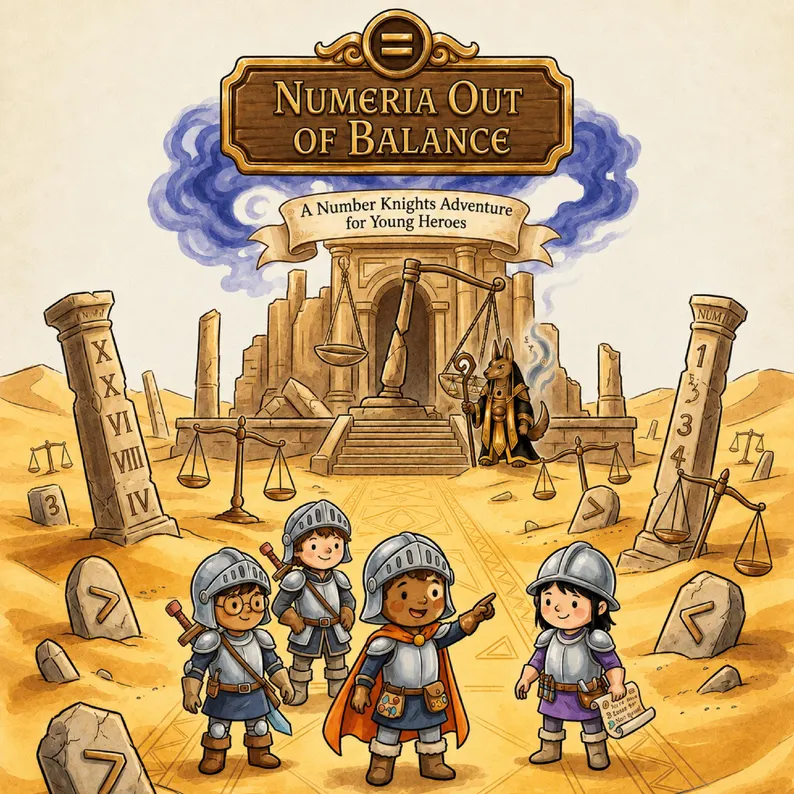
Numeria Out of Balance
Equal, more, less, bigger, smaller, and fairness, after the Equal Sign itself is stolen. See the product page →
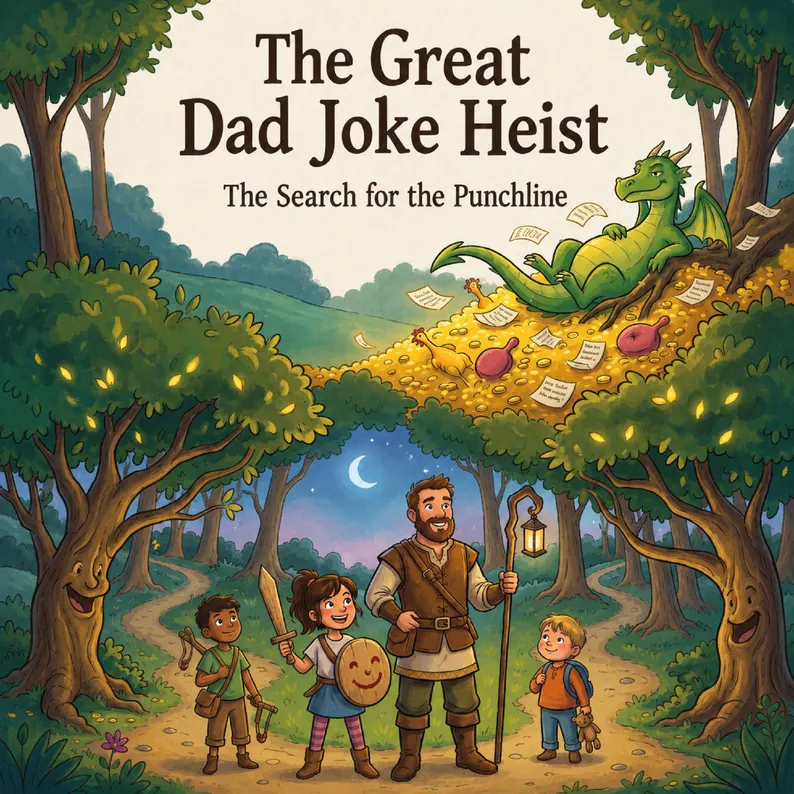
The Great Dad Joke Heist sits outside the Numeria sequence as a standalone one-shot built for a mixed-age family table: younger kids use the same simple rules, older kids can bring a real D&D character. See its product page → for details.
Free printable games and the Roblox game
Want to try the idea before you buy anything? These printable games are free and take about twenty minutes: The Great Equation Crystal Hunt, Countingbrook Number Bingo, and The Fair-Share Market.
If your child likes video games, Kingdom of Numeria is also a Roblox game. It has spell combat and boss fights, and the first three chapters follow the storybook adventures above. Try it yourself first.
FAQ
Can a preschooler play?
Yes. These adventures are built for ages 3 to 7, which includes preschool-age children.
Does my child need to read?
No. An adult reads the story aloud while the child makes choices, counts, and points at things.
Do I need D&D or Game Master experience?
No. These are designed for parents and caregivers without previous Game Master experience.
Can I play with only one child?
Yes. Each Kingdom of Numeria chapter is built for 1 to 4 child players plus one adult, including solo play.
How long should we play?
60–90 minutes per chapter, or up to about 2 hours with every optional scene. Each chapter is written to split at a scene break if your child needs a shorter session.
Is combat required?
No. Outcomes are built around choices, counting, and story problems, with a simple d20 roll for uncertain moments, not a combat-focused system.
What do I need to print?
Each Kingdom of Numeria chapter includes matching challenge and coloring sheets used as the story's visual puzzles. Everything else is read straight from the page.
Where should we begin?
The Missing Three, Chapter 1 of Kingdom of Numeria.