
Free to use at home or in the classroom. Download the PDF above, or use Print to print just the sheets, not this page.
The story
In the Scale-Sand Desert market, the Equal Sign has been stolen. The Equal Sign is the symbol-stone that helps the world compare and balance things. Without it, things can become bigger, smaller, heavier, lighter, fair, or unfair for no reason at all. The traders' scales have stopped telling the truth, and a calm old knight named Lady Tenna has come to set things right.
Your child is the Number Knight who helps her decide: which side has more, which has less, and what would make both sides the same?
Who you play
You are Lady Tenna of the Tenth Crystal, an old Number Knight who once helped guard the Great Equation. She is calm, serious, and kind, and she speaks slowly, as if she is measuring every word before she says it. Try her lines:
- “The market has forgotten fair trades.”
- “Follow the imbalance. The too-heavy feather. The too-small hill. The unfair trade. They will all point the same way.”
- “Long ago, the desert was a place of measuring stones and fair scales.”
You are also the desert trader, who waves both arms and cries, “Come come, I have the best deals!” and insists, “The scale says it’s equal!” even when it is not. Your child’s job is to say why it is not fair. And watch out for the Jackal Judge, who believes fairness is weakness and declares wrong things as if they were true: “Small is bigger!” “Less is more!” Your child can correct him.
Get ready
- Press the Print button above. Four sheets come out: the scale, six answer cards, a sheet of dates, gems, and shells, and a page of questions for you.
- Cut the dates, gems, and shells into squares along the dotted lines. There are 20 of each. Slicing the sheet into strips first makes it quick.
- Cut the six answer cards apart.
- Lay the scale flat on the table.
How to play
- Read a question from the grown-up sheet, like “A trader puts 1 date on one side and 8 gems on the other. He says the scale says it’s equal. Is he right?”
- Set up the dates, gems, or shells in the two trays, or let your child do it.
- Your child counts each side out loud.
- Your child holds up an answer card: THE SAME, LEFT HAS MORE, or RIGHT HAS MORE.
- Then ask the big question as Lady Tenna: “How could we make it fair?” Your child moves goods from one tray to the other, counting as they go.
A real balance tips toward the heavier side, so on this printed scale say it out loud: “The side with more goes down.” Many questions have more than one good answer. If your child has a different way to make it fair and can explain it, that is a win.
Make it easier or harder
- Ages 3 to 4: Compare two small groups of 1 to 4 goods. Use only the first kind of question: which side has more?
- Ages 5 to 6: Use groups up to 8 and ask the fair-share questions.
- Ages 6 to 7: Add the last questions on the grown-up sheet, which bring in taking away, sharing fairly, and trading two shells for a gem.
Talk about it
- How did you know which side had more?
- What is another way to make it fair?
- Is it fair if one side has dates and the other has gems, but there are the same number of each?
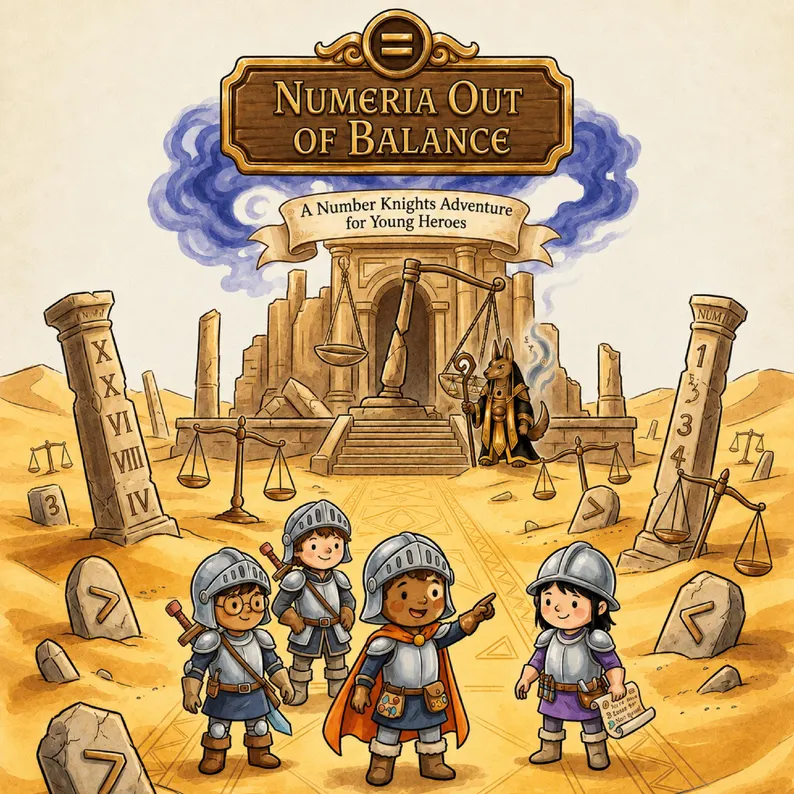
Numeria Out of Balance
In Chapter 3 the Equal Sign is stolen, Lady Tenna arrives to guide the Number Knights through the Scale-Sand Desert, and the trail ends at the Jackal Judge, who hates balance. It is a 35-page story-first adventure with the same simple Number Knights rules and 12 printable challenge and coloring sheets, in color and line art.
More free games for young heroes
- The Great Equation Crystal Hunt, a printable hide-and-find game for the numbers 1 to 10.
- Countingbrook Number Bingo, a printable counting bingo for 1 to 8 players.
- The Bridge of Three Lanterns, a 15 minute counting story you read aloud.