
Free to use at home or in the classroom. Download the PDF above, or use Print to print just the sheets, not this page.
The story
Plus Goblins are small, green, greedy, nervous, and very easily impressed. They live in a messy camp in the Forest of Figures, sorting buttons, spoons, pebbles, and bottle caps into piles, and they shout “Mine!” at almost everything.
Nib-Nab is the goblin who tests every new Number Knight. He puts down a pile of shiny things and asks one question: “How many shinies?” Get it right and the goblins are impressed. This bingo game is his test.
Who you play
You are Nib-Nab. Use your best goblin voice. Nib-Nab is greedy and bossy, but he is easily impressed when a Number Knight gets it right. His lines:
- “You want shiny number pieces? Fine! Goblin test.”
- “How many shinies?”
- “Mine! No, mine!” (when anyone covers a number too fast)
- “Three shinies and three more shinies. Now how many?” (for the harder round)
Get ready
- Press the Print button above. You get two sheets of bingo cards (four per sheet) and one sheet of calling cards.
- Cut the calling cards apart along the dotted lines and shuffle them. These are Nib-Nab's piles of shinies.
- Give each player one bingo card and about nine markers.
How to play
- Hold up one calling card and say, “How many shinies?”
- Everyone counts the shinies out loud together.
- Players find that number on their card and cover it with a marker. Not every number is on every card, so some players will have nothing to cover. That is part of the game.
- The first player to cover three in a row, across, down, or corner to corner, calls “Bingo!”
For a longer game, play “cover the whole card” instead. Keep going until a player has covered all nine numbers.
Why the shinies are in two rows
On every calling card, the shinies are lined up in rows of five, like a ten-frame in a math class. A child who sees one full row and two more can start to think “that is five and two more, so seven” instead of counting every shiny one at a time. The little dots on each bingo square work the same way.
Make it easier or harder
- Ages 3 to 4: Say the number name out loud as well as counting. Point to the numeral on the card and say it together. Cover any square you like, there is no need to hurry.
- Ages 5 to 6: Play it as written. Count the shinies and find the number alone.
- Ages 6 to 7: Play Nib-Nab’s harder round. Hold up two calling cards at once and ask, “Three shinies and three more shinies. Now how many?” Players cover the total. Or hold up a card and say “Find one more than this.”
Talk about it
- Which pile of shinies was the biggest?
- Can you find a number that is one more than the card I'm holding?
- Which number on your card has the fewest dots?
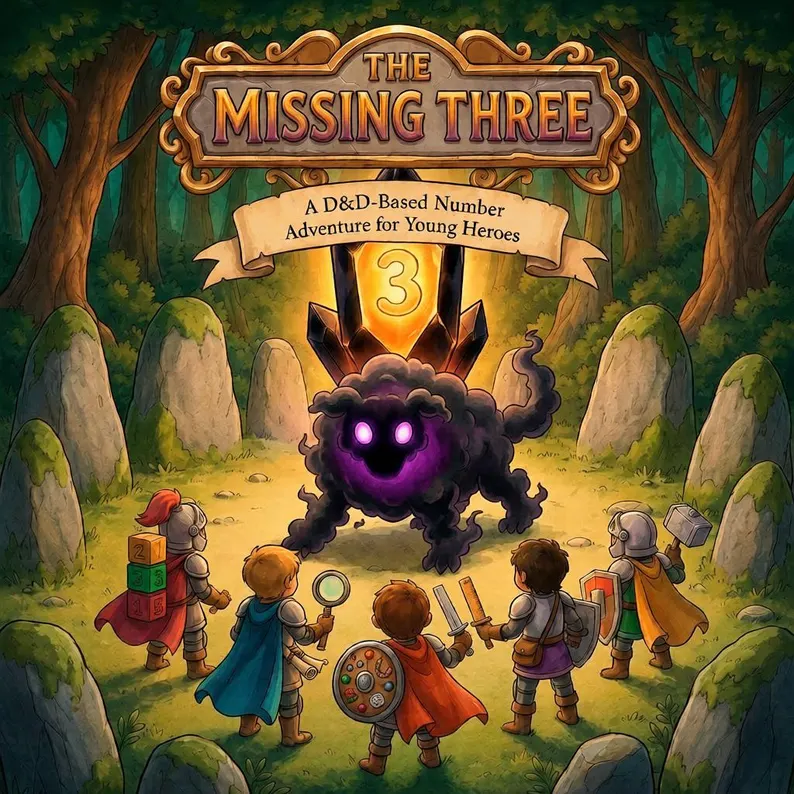
The Missing Three
In Chapter 1 the Number Knights find a Plus Goblin camp deep in the Forest of Figures, where goblins are arguing over golden fragments and Nib-Nab gives them a counting test. It is a 27-page story through Countingbrook and the forest where counting is what moves the story forward. Characters take about a minute to make, and no reading is needed.
More free games for young heroes
- The Great Equation Crystal Hunt, a printable hide-and-find game for the numbers 1 to 10.
- The Fair-Share Market, a printable balance game about more, less, and fair.
- The Bridge of Three Lanterns, a 15 minute counting story you read aloud.