
Almost everyone's first game of Dungeons & Dragons is a bit of a mess, and that is part of the fun. Your Dungeon Master expects you to forget a rule, ask a question, and try something odd. These tips are the short list that actually helps.
The basics below, like turn order, advantage, death saves, and resting, work the same in the 2014 and 2024 versions of the Player's Handbook. Where the books differ, your Dungeon Master has the final say.
Know five things on your character sheet
A character sheet looks like a tax form. You can ignore most of it for the first session. Find these five things and you can play:
- Armor Class (AC). How hard you are to hit. Enemies need to roll this number or higher.
- Hit points (HP). How much damage you can take. At zero you fall unconscious.
- Speed. How far you can move on your turn, usually measured in feet.
- Your attacks or spells. The two or three things you will do most often, with the number to add to the roll already worked out.
- Your best ability. The score that defines your character. A fighter is strong, a rogue is quick, a wizard is clever.
Write your top three actions on an index card and keep it next to your sheet. It saves a surprising amount of time.
What you can do on your turn
Every turn works the same way. You can move, take one action, and sometimes take one bonus action. You also get one reaction each round, which you can use when something happens on someone else's turn.
- Move up to your speed. You can split your movement around your action.
- Take an action. Attack, cast a spell, dash to move farther, dodge to make attacks against you harder, help an ally, hide, or try something else you can describe.
- Use a bonus action, if your class has something that uses one, such as a barbarian's Rage or a fighter's Second Wind. If yours does not, you can ignore this one.
One caution: if you walk away from an enemy next to you, it can usually take a free swing at you, called an opportunity attack. Using the Disengage action avoids it.
Say what you want to do, then roll
D&D is a conversation. Describe what your character does, and the Dungeon Master tells you whether to roll. Most rolls are a twenty-sided die, plus a number from your sheet, against a target number. If you are not sure what to roll, ask: "I want to climb the wall, what do I roll?" Nobody minds.
You are not limited to the buttons on your sheet. If you think of something clever, like swinging from the chandelier or flattering the guard, say it. The best moments of most games come from ideas that were not on anyone's character sheet.
Advantage and disadvantage
When something helps you, you have advantage: roll two twenty-sided dice and take the higher. When something hinders you, you have disadvantage: roll two and take the lower. This is the single most common rule you will see, and your Dungeon Master will remind you when it applies.
How not to die at low level
At level 1, characters are fragile. A lucky hit can knock out a character in a round or two, so low-level play rewards caution more than bravery.
- Stay near your friends. Splitting up is how a weak party loses to a weak monster.
- Use cover and doorways. Fighting in a narrow place means fewer enemies can reach you at once.
- It is fine to retreat. Running away from a fight you are losing is a good plan, and it often makes a better story than a heroic death.
- Do not hoard your resources. If you have a healing potion and a friend is at zero, use it.
When you reach zero hit points you do not die automatically. You fall unconscious and make death saving throws on each of your turns. Ten or higher on the die is a success, three successes and you stabilize, and three failures mean death. Healing, even a small amount, brings you right back up.
Rests bring you back
A short rest takes at least an hour and lets you spend hit dice to heal. A long rest takes about eight hours and restores most of what you have lost. Many classes get abilities back on a rest, so ask your Dungeon Master when the party can take one, especially before a big fight.
Pick a class that fits how you like to play
If you want something simple to run for your first session, a fighter or a barbarian has few things to track. A rogue adds a bit more choice, and spellcasters like wizards and druids have the most options and the most to read. None of them is wrong, and a spellcaster is fine if you like reading. Whatever you choose, read your own abilities once before the session, because the person who knows your character best is you.
Be a good teammate
- Give everyone a turn to talk, especially quieter players.
- Build on other people's ideas rather than topping them.
- Keep your character connected to the group, even if they are grumpy about it.
- If something at the table makes you uncomfortable, tell the Dungeon Master. A good table will change course.
Try a short game first
If you would rather test the water than commit to a whole evening, the free encounters on this site each take 30 to 45 minutes and need no preparation, so they make a gentle first session. If your table wants to play for longer, Goblins GO BOOM is a complete adventure for levels 3 to 5.
If you are the one who will be running the game, start with How to Run Your First D&D Game.
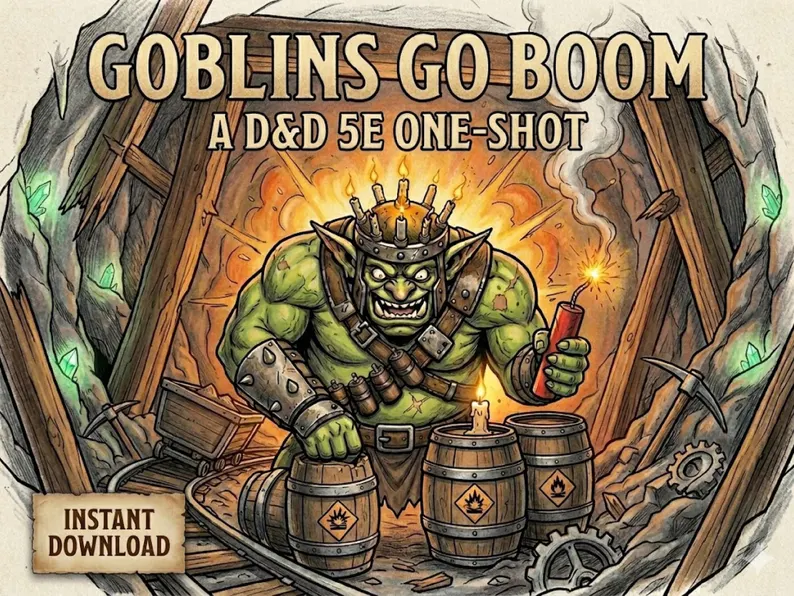
Goblins GO BOOM
A levels 3-5 demolition dungeon with a Chaos tracker, four routes into the mine, a two-phase finale with a five-round collapse, and maps and tokens included.
The one-card summary
- Know your AC, HP, speed, best attacks, and best ability.
- On your turn: move, one action, maybe a bonus action.
- Say what you want to do, then roll if asked.
- Advantage means roll two and take the higher.
- Stay together, retreat when you must, and heal your friends.
- Ask questions. Everyone does.