
A low-prep one-shot puts your hour into the parts the table will actually touch, and skips everything the players would never see.
The minimum you actually need
If a one-shot has these seven things, you can run it. If it is missing any of them, you will be inventing them live.
- A problem in one sentence. "The mine is about to collapse and three surveyors are still inside." Players should understand it within ten minutes.
- A villain with a want. Not a backstory, a want. What are they trying to do tonight?
- Three scenes. An opening, a complication, and a finale. Everything else is optional.
- Two or three creatures you will really use. With their stat blocks ready, and a note on what each does on its turn.
- A visible clock. Something that gets worse over time, like a fuse, a pursuit, or a ritual.
- One map or one good description. For the place where the finale happens.
- An ending. What happens when the party wins, and what happens when they do not.
What to leave improvised
This is where most of the time you would have spent is wasted.
- NPC dialogue. Know what they want, then talk.
- Room descriptions beyond the few that matter.
- Exact loot. Decide what the party gets when they earn it.
- Shop inventories, tavern menus, and side characters' backstories.
- Names for everything. Keep a list of five names and cross them off.
The test is whether you would be embarrassed to improvise it. If not, do not prep it.
Prep what you can read aloud
The prep that pays off most is anything you can use directly at the table: a paragraph to read when the scene opens, a short table to roll on when the party goes off-script, a list of what the villain does each round. Prose you have to paraphrase on the spot is prep you did not need to do.
Keep detours optional
Side rooms, secrets, and extra NPCs are fine, as long as they are routes around the three main scenes, not gates the party has to pass through. A good low-prep one-shot lets you cut a scene without breaking the story. The Huntsman's Game even includes five alternate hooks so it drops into whatever campaign you are already running.
A fifteen-minute pre-session checklist
- Write the one-sentence problem on an index card.
- Write the villain's want and the ending next to it.
- List the three scenes under it.
- Pull the two or three stat blocks you need and mark their main actions.
- Decide the clock and what happens when it runs out.
- Write five names on the back of the card.
For more on keeping a one-shot to a single night, see D&D One-Shots for Levels 3-5.
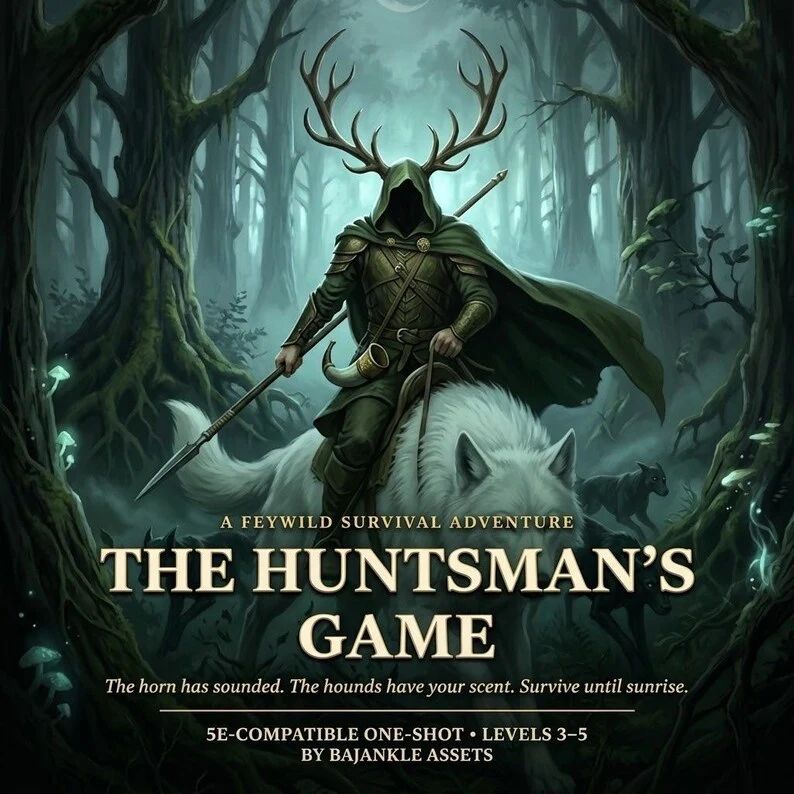
The Huntsman's Game
A 21-page, levels 3-5 Feywild one-shot built around Trail, a 0-to-3 scale that tracks how close the pack is. It runs 3 to 5 hours and includes a printable DM Hunt Tracker.