
A fight that takes ninety minutes feels like a great story for about twenty of them. After that, the table is on its phones and you are rolling for the sixth kobold.
A handful of habits fixes most of it, split between you and the players.
Find where the time goes
Next time you run a fight, notice what stalls it. There are three common culprits: players deciding what to do only when their turn arrives, you rolling and adding up damage for every attack, and too many enemies with too many things to track.
Once you know which one it is, the fix is obvious.
Ask players to decide before their turn
The biggest single improvement is a rule about whose turn is next. When you finish one turn, say who is up and who is on deck. The player on deck should decide what they will do while the current turn plays out.
It also helps if players know their main moves. Ask each of them to write their three most-used actions on an index card in front of them. "I swing my axe" is faster than a search through the sheet.
Take shortcuts on your side
- Use average damage. Stat blocks list an average in parentheses next to the dice. For minor enemies, just say "that hits for seven" and skip the roll.
- Group identical monsters. A common table rule is to roll initiative once for a group of the same creature and let them act together.
- Keep enemy tactics simple. Decide what each creature type does before the fight starts. "The archers shoot whoever is closest" is a perfectly good plan.
Give enemies jobs, not just hit points
Four identical enemies mean four turns of the same thing. Two or three enemies with clear roles make the fight easier to run and more interesting to play. One holds the doorway, one shoots from cover, one tries to grab the objective. Players can read the room and make choices instead of just hitting the nearest target.
Give the fight a goal besides damage
Fights drag when the only way to end them is to reduce everything to zero. Add a second objective: stop the ritual, hold the gate for four rounds, get the cart through the tunnel. Now there is a reason to move, and a way for the fight to end before the last goblin falls.
Know when to stop
When the outcome is decided, end the fight. If three enemies are down and the last one is nearly dead, narrate the finish. "The last goblin drops his club and runs for the tunnel. Do you chase?" turns three more rounds into one good beat.
Enemies also should not fight to the death. Let them flee or surrender when the fight turns against them. It is more believable, and it saves time.
Use the grid only when position matters
Not every fight needs a map. A small scuffle in a corridor can run as a description, while a battle with area spells, cover, and tricky terrain is worth a grid. If you find yourself arguing about distances, switch to the map. If nobody is checking, put it away.
Try this once
Time a single round with your phone, then show the table the number. Seeing it is usually enough to get everyone speeding up on their own.
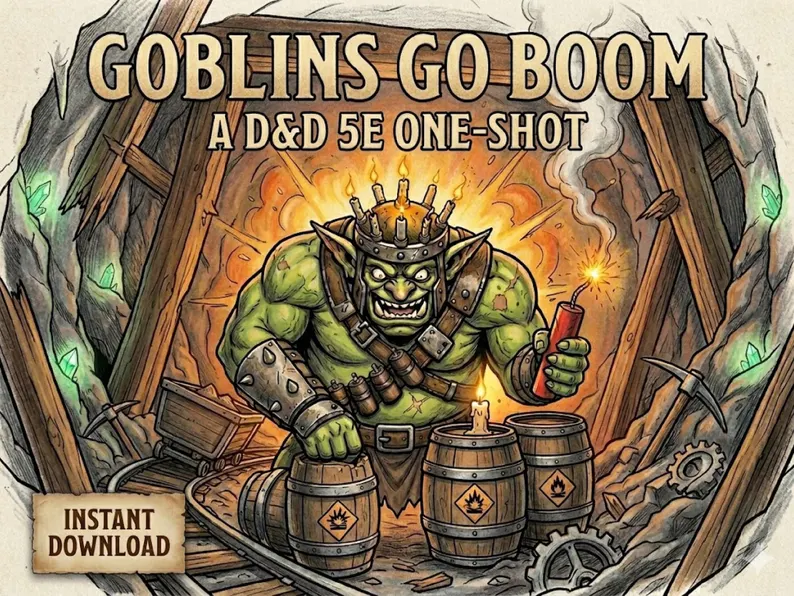
Goblins GO BOOM
A levels 3-5 demolition dungeon with a Chaos tracker, four routes into the mine, a two-phase finale with a five-round collapse, and maps and tokens included.
A faster-combat checklist
- Announce who is up and who is on deck.
- Players write their three main actions on a card.
- Use average damage for minor enemies.
- Roll one initiative for each group of identical monsters.
- Give each enemy a clear job.
- Add an objective besides damage.
- End the fight when the result is clear.