
Your first game will not go the way you planned it. Someone will ignore the obvious door, someone else will adopt a shopkeeper as a best friend, and you will forget a rule. All of that is normal, and none of it means you ran it badly.
So aim lower than a great campaign. Aim for one evening that ends with something actually happening.
Pick the smallest game that works
Run a one-shot: one adventure, one session, a real ending. Three to four hours is a good size for a first game, because it is long enough to feel like an adventure and short enough that you can survive your own mistakes.
Level 3 is a comfortable place to start. Most characters have picked up a subclass by then, so players have a few interesting options, but nobody is juggling a dozen abilities yet.
Use a premade adventure the first time. Writing one is a separate skill, and you are already learning a lot just by running the table. If you want to try the feel of it first, the free encounters on this site run in 30 to 45 minutes each and need no map or special setup. When you want a full evening, The Huntsman's Game is written for 3 to 5 hours.
An hour of prep, spent in this order
- Read the whole adventure once (about 20 minutes). Skim the sidebars. You are looking for the shape of the night, not memorizing it.
- Write one index card (10 minutes). Put four things on it: the problem the party is facing, what the villain wants, the three scenes you expect, and how the adventure ends. That card is your real notes. Everything else is reference.
- Read the stat blocks you will use (10 minutes). Pick the two or three creatures that matter and note what each one actually does on its turn. Most monsters have two moves worth remembering.
- Name five NPCs (5 minutes). Write five names on the card. When a player talks to a random villager, you will be glad you did.
- Set the table (15 minutes). Dice, pencils, character sheets, a few blank index cards for initiative, snacks. If the game is online, test that everyone can see the map.
The card is the whole trick
New Dungeon Masters lose the thread because their notes are a book. A single card you can read in five seconds gets you back on track mid-scene, with no page-flipping while four people watch you.
Run the first fifteen minutes on purpose
The opening decides the energy of the night. Start in the middle of something rather than in a tavern, and keep your first description to three or four sentences.
Then ask each player one question: how does your character know why they are here? One sentence each is enough. It gives everyone a voice before anyone has to roll a die, and it hands you hooks you can use later.
End the scene with a question: "What do you do?" Then stop talking. The silence feels long, and it is the most useful thing you will do all night.
Say yes, or ask for a roll
When a player tries something, you have two good answers. If it is plausible and nothing is at stake, say yes and move on. If it could fail in an interesting way, ask for a roll.
The Player's Handbook gives a simple difficulty ladder you can lean on: 10 for easy, 15 for moderate, 20 for hard. You will use 10, 15, and 20 for most of the night. Advantage and disadvantage cover the rest: if the situation helps the player, they roll two d20s and take the higher, and if it hurts them, the lower.
Rules you can safely ignore
You do not need to enforce carrying capacity, track every arrow, or measure rope. If a rule is not making the game more fun, skip it.
For the rules you do need, here is the one that saves new Dungeon Masters the most grief: if you cannot find a rule in about thirty seconds, make a ruling, say it out loud, and keep going. Jot it on your card and look it up after the session. Nobody will remember the pause, but they will remember a stalled scene.
When the players get stuck
Sooner or later the party will stare at you with no idea what to do. Do not give the answer straight away. Work up a ladder:
- Ask what their characters notice.
- Point at one specific detail in the room.
- Offer two options and let them choose.
If none of that works, put the clue somewhere else. A good adventure should never depend on a single door being opened.
End the night on purpose
When the party achieves the goal, end the adventure. Do not add one more fight because you have time. Give each character one sentence of epilogue, then ask the table what they enjoyed. One question is enough, and you will learn more from it than from an hour of prep next time.
New Dungeon Masters tend to worry about doing voices, knowing every rule, and pacing. Players mostly remember whether they had a decent time and want to play again.
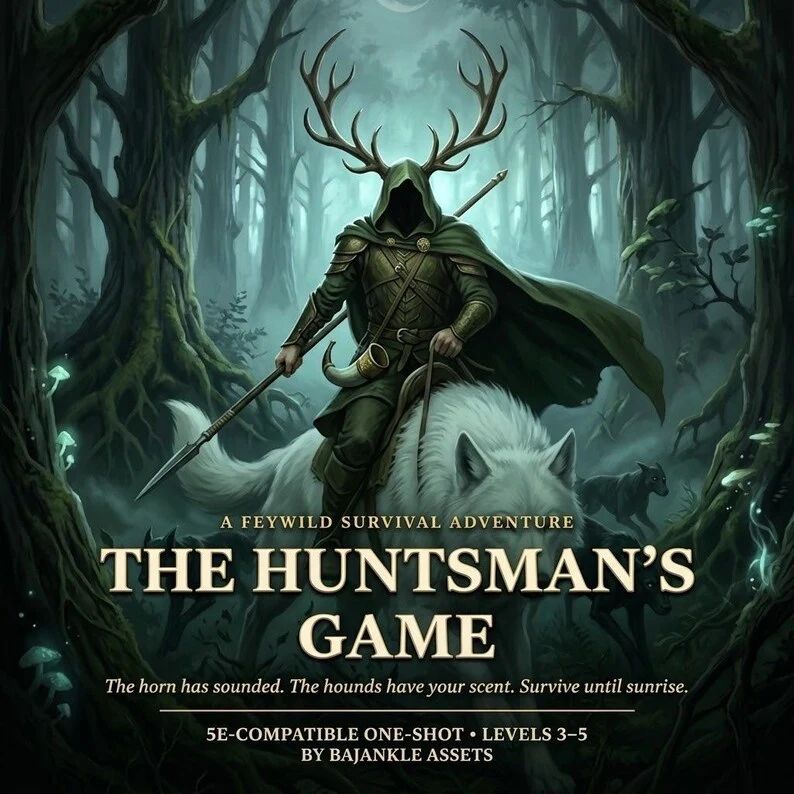
The Huntsman's Game
A 21-page, levels 3-5 Feywild one-shot built around Trail, a 0-to-3 scale that tracks how close the pack is. It runs 3 to 5 hours and includes a printable DM Hunt Tracker.
Your first-game checklist
- One adventure you have read all the way through.
- One index card with the problem, the villain's goal, three scenes, and the ending.
- Five NPC names written down.
- Dice, pencils, character sheets, and a pile of blank cards.
- A plan to start in the middle of a scene.
- A plan to stop when the goal is reached.