
Free to use at your personal table. Use your browser’s Print command to save this page as a PDF.
The situation
The party reaches a welcoming roadside inn just as a storm begins. Inside, a nervous goblin named Nib welcomes them to a free four-course dinner. The food is surprisingly good, the chairs are comfortable, and the fire is warm.
Then one of the chairs licks somebody.
Nib insists this is perfectly normal. It isn’t: the entire inn is an enormous mimic, the furniture is its brood, and tonight’s dinner is their first attempt at proper hospitality. The party isn’t meant to be the meal.
Probably.
What you need: this page and something to roll checks with. No special map or stat blocks required. Read it straight from the screen or a printed copy.
Read aloud
Warm golden light spills from the windows of a crooked roadside inn. Its sign reads THE HAPPY TRAVELER, though several letters appear to have been chewed.
The door swings open before anyone touches it.
A goblin in a spotless white apron bows from the waist. Behind him waits a long dining table set with silverware, steaming bread, and exactly enough chairs for each of you.
“Guests!” he cries. “Real guests! Please, come in. Dinner is free, the beds are soft, and nothing in here has eaten anyone for nearly a month.”
One of the chairs quietly pulls itself away from the table.
The goblin kicks it.
“We discussed this.”
What everyone can see
- Nib, the goblin host, is sweating despite the cold.
- The table has been set for exactly the right number of guests.
- A wooden high chair sits empty at the head of the table.
- The fireplace occasionally breathes in.
- Several scratches run across the inside of the front door.
- A suit of armor stands in the corner with two wet eyes inside its helmet.
- Something beneath the table keeps bumping against everyone’s feet.
- A brass dinner bell sits beside Nib’s place setting.
Nib asks everyone to sit. When they do, the chairs tuck themselves in.
The rules of the house
Nib nervously explains the inn’s rules:
- Everyone must remain seated while food is being served.
- Every guest must try at least one bite from each course.
- Nobody may insult the cooking.
- Nobody leaves before dessert.
- If the house asks whether everything is delicious, the answer is yes.
Nib didn’t create these rules. The house did.
The four courses
Each course lasts as long as the party needs to investigate, argue, eat, cheat, or panic. Ringing the brass bell brings out the next course.
| Course | What is served | What happens |
|---|---|---|
| 1 | Bread and yellow butter | The bread is excellent. A character who drops food notices the floorboards pulling it into a narrow seam. |
| 2 | Turnip soup | The spoons try to feed anyone who refuses to eat. They are persistent but initially harmless. |
| 3 | Roast mystery bird | The front door locks. The empty high chair begins chewing on the table. |
| 4 | Red velvet cake | The walls tighten, the fireplace opens one enormous eye, and the house asks, “Did you enjoy your meal?” |
At the end of each course, the house becomes less able to hide what it is.
The meal is genuinely safe. The danger comes from frightening, insulting, attacking, or disappointing the house.
Actions that matter
Use whatever checks fit your system. For 5e-style play, DC 11–14 is enough for most actions. Strong ideas can simply work.
- Question Nib. He admits the furniture is alive but initially avoids discussing the building.
- Examine a chair. Its legs have joints, its cushions are warm, and a row of tiny teeth hides beneath the seat.
- Look beneath the table. A puppy-sized footstool mimic is searching for dropped food.
- Feed the furniture. A fed mimic becomes friendly and stops causing trouble.
- Inspect the front door. Its brass handle is attached to something resembling a tongue.
- Search the kitchen. There is no pantry. Ingredients are pushed out through a fleshy opening in the wall.
- Talk to the house. It understands speech but has the emotional judgment of a frightened child.
- Break a rule deliberately. This reveals more of the house, but it also makes the house feel threatened.
- Compliment the meal. Sincere praise calms the house. Obvious lies do not.
- Escape through a window. The windows can close their shutters like eyelids, but they can be distracted.
- Attack the building. This works, but everyone is currently standing inside it.
Nib
Nib found the abandoned inn six months ago while hiding from a storm.
The inn ate his backpack, tasted his boots, and then decided not to eat him. Nib has lived here ever since.
He believes the building is lonely rather than evil. Unfortunately, his plan to teach it hospitality has mostly involved shouting things like “Guests don’t like being digested!” whenever something goes wrong.
Tonight is important. This is the first time the house has welcomed travelers without immediately trying to swallow them.
Nib desperately wants dinner to succeed.
He also knows the most important secret: the house does not want food. It wants guests who choose to stay.
The empty high chair
The high chair belongs to Nibble, the youngest mimic in the house. Nibble and the high chair are the same creature: too nervous to hold its assigned shape, it has slipped out from the table and is currently hiding beneath it as a small footstool instead. That's why the chair sits empty until it starts chewing the table on its own.
Nibble is afraid of adventurers because the last travelers attacked it on sight.
If a character feeds, pets, or reassures the footstool, Nibble follows them for the rest of dinner. The high chair stops chewing the table and behaves itself.
If anyone harms Nibble, the entire building reacts immediately.
Every door locks. The furniture bares its teeth. The ceiling lowers several feet.
The house does not attack yet. It gives the party one chance to apologize.
What happened to the last guests?
Three adventurers visited the inn several weeks ago. They discovered what it was and tried to burn it down from the inside.
The house survived. The adventurers escaped.
Nib is telling the truth when he says nothing here has eaten anyone for nearly a month. He simply leaves out the fact that the inn ate six bandits shortly before that.
Evidence of the bandits remains upstairs:
- A sword embedded in a bedroom wall
- Several abandoned boots
- A shield with a large bite missing
- A backpack slowly being digested beneath a rug
- A note reading, “THIS IS NOT AN INN”
The rug has tried to eat the note.
When the house reveals itself
During dessert, the shutters close and the room falls silent.
The fireplace opens a large amber eye. The walls expand and contract with a slow breath. The front door grows a row of blunt wooden teeth.
Then the house asks:
“Did you enjoy your meal?”
The voice comes from every wall at once.
The party must decide how to answer.
If the party says yes
The house is delighted, but it does not unlock the door.
It asks them to stay for breakfast.
Then lunch.
Then another dinner.
It has only just learned how pleasant guests can be. It sees no reason they should ever leave.
The party must convince it that good hosts allow their guests to go home. Mentioning that travelers may return with friends is particularly effective.
Nib supports this argument once he realizes the house intends to keep everyone forever.
If the party says no
The house begins to cry.
Warm, sticky fluid leaks from the ceiling. The furniture becomes agitated, the floor tilts toward the kitchen, and the front door starts chewing.
The party has two rounds to calm the house, escape, or force it to spit them out.
If the party attacks
Use ordinary mimic statistics for animated furniture if combat is wanted. Two or three furniture mimics are enough for most groups.
The building itself should be treated as an environment rather than a creature with hit points.
Each round, choose one complication:
- The floor becomes sticky and restrains careless movement.
- A doorway bites at anyone passing through it.
- The room tilts toward the hungry fireplace.
- The ceiling presses downward.
- A window opens somewhere unexpected.
- Nib throws food to distract one of the furniture mimics.
- Nibble tries to protect whichever character treated it kindly.
The party escapes by reaching the front door, creating another opening, frightening the house into releasing them, or making peace.
Other ways out
The party does not have to finish dinner politely.
- Teach the house manners. Demonstrate that guests must be allowed to leave if they are ever expected to return.
- Promise to send other travelers. The house opens the door but expects the party to keep its word.
- Offer it a job. A living inn could travel, guard a road, hide fugitives, or serve as an extremely unusual base.
- Give the house a present. It has never received one and releases the party out of confused gratitude.
- Make it sneeze. Pepper, smoke, dust, or irritating magic can force every door and window open at once.
- Convince it that eating guests is poor hospitality. Nib has been attempting this for months and happily provides supporting testimony.
- Burn it from the inside. This is effective, dangerous, and likely to make Nib very upset.
If the party befriends the house
The Happy Traveler remembers anyone who treated its family kindly.
If the party returns, the inn may appear somewhere new. It is not attached to its foundations as firmly as an ordinary building, and it moves at night when no one is watching.
Friendly characters receive:
- A free meal and a safe night’s rest
- Rumors collected from previous travelers
- A footstool mimic that follows them around
- A room capable of hiding people from pursuers
- One warning whenever something dangerous approaches the inn
The house still occasionally eats rude customers.
Nib is working on it.
Rewards
- Nib gives the party a dinner bell that can summon a small animated spoon once per day.
- A friendly furniture mimic may follow the party as a harmless companion.
- The house knows what has traveled along the road during the previous month.
- The roast restores a modest amount of health. Nobody knows what kind of bird it was.
- Characters who finish all four courses receive a wooden token reading POLITE GUEST.
Showing the token prevents the Happy Traveler from biting them during future visits.
Usually.
How to scale it
Easier: Nib explains the truth during the second course, and the house accepts any believable promise to visit again. Harder: one piece of furniture is actually hungry and acts against the house’s wishes. The party must identify it before its behavior convinces everyone that the entire inn is hostile.
For a more horrifying version, the upstairs guest rooms contain belongings from dozens of previous visitors, and some of the furniture can repeat their voices.
For a more comedic version, every piece of furniture has a different personality. The chairs compete for guests, the rug begs to be stepped on, and the coat rack becomes jealous whenever anyone keeps their cloak.
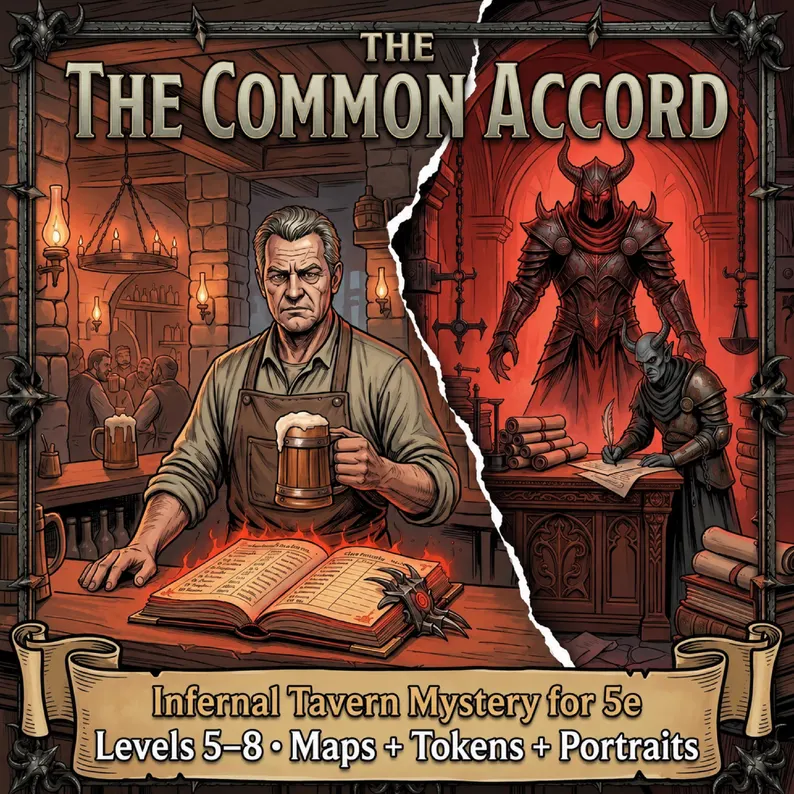
The Common Accord
If you enjoyed Dinner at the Hungry House, The Common Accord is another complete tavern one-shot: this time featuring a mysterious ledger, an unsettling tavernkeeper, and an infernal secret waiting behind the bar.
See the full adventure on Etsy ↗