
Free to use at your personal table. Use your browser's Print command to save this page as a PDF.
The situation
After the last show of a traveling Fey playhouse, a polite stagehand in a half-mask invites the party backstage. He is the Understudy, and he says the Director would like to thank the audience in person. The party ends up in a long dressing room lit by candles in jars, with costumes on rails and one tall mirror in a gold frame. The door closes behind them, softly.
The Understudy offers a game. One party member steps up to the mirror, and the mirror lends them a friend: an exact copy, called the Double. The party must work out which of the two is the real character before the third bell rings. If they do, the door opens. If they do not, the show gets a new lead.
What you need: this page and something to roll checks with. No map or stat blocks. Pick which character gets copied before you start, ideally one whose player enjoys a bit of theatre.
Before you start: a note for the table
This scene copies one player's character and has the party doubting each other for a few minutes. Tell the table up front that the doubt is in character only. Ask the player whose character will be copied if they are happy to be the one. Agree that anyone can say "pause" at any time to stop and check in. You play the Double, not another player.
The rules of the room (for you)
- The Understudy never says anything untrue. He does not have to answer fully. Ask him which one is real and he might say, "Both of them are standing in this room."
- The Double never says anything untrue either. It has the character's memories, voice, and manners up to the moment of the copy, and it dodges the way a good actor does.
- Every illusion in this room has exactly one flaw. Choose one from the table below and keep it consistent. The real character can notice it too, and that is part of how they prove who they are.
- The room itself is a stage illusion. Magic that detects illusions shows an aura on everything, so it does not point at either character.
Read aloud
The mirror ripples like water. A figure steps out of the glass wearing the same face, the same gear, and the same half-smile as one of you. The Understudy claps once. "Two of you now. Lovely. A hundred bells ago a very famous actress got this wrong, and we are still not over it. You have three bells. Ask what you like. Find the lie, and mind the door."
Pick the flaw
| d6 | The Double’s flaw |
|---|---|
| 1 | Its reflection in the mirror moves half a second late. |
| 2 | It holds weapons and tools in the wrong hand. |
| 3 | It casts no shadow under the candlelight. |
| 4 | It smells faintly of stage paint and old velvet. |
| 5 | It never blinks while someone is looking at its eyes. |
| 6 | Its voice is perfect, but it never echoes in the room. |
The three bells
| Round | What happens at the end of the round |
|---|---|
| 1 | Both characters stand in the light and the questions begin. The Understudy answers any question truthfully and exactly as asked. |
| 2 | First bell. One candle goes out. The Double gets bolder and starts finishing the real character’s sentences. Offer the first hint: "Something about one of them is a little off." |
| 3 | Second bell. Another candle goes out. The room goes quiet. Offer the second hint: point at where the flaw lives (the mirror, the hands, the floor, the air, the eyes, or the sound). |
| 4 | Third bell. The Understudy asks the party to choose. Resolve below. |
Actions that matter
Use whatever checks fit your system. For 5e-style play, DC 11–14 is enough for most things here. Good ideas can simply work.
- Ask a question. The real character answers plainly. The Double answers truthfully but sidesteps. An Insight check (DC 12) tells a character that one of them is choosing their words carefully.
- Test them. Ask both to do something physical, hold something, or stand in a particular spot. This is how flaws 2 and 3 show up.
- Use the mirror. Looking into it with care reveals flaw 1, and a hint for the rest.
- Ask the Understudy. He is honest and unhelpful in equal measure. A clever, exact question gets an exact answer.
- Refuse the game. If every party member says plainly that they do not want to play, the door opens. The Double stays behind with a flourish, and no prize is offered.
When the third bell rings
| The party’s choice | What happens |
|---|---|
| Names the real character and says what the flaw is | The Double dissolves into drifting stage paint. The Understudy bows and gives the party his half-mask (see Rewards). |
| Names the real character but cannot say the flaw | The door opens and the Double fades. The Understudy shrugs: no prize, but no harm done. |
| Names the wrong one | The real character is lifted gently into the wings and returns when the door opens. The Double leaves with the party, still copying the character, still carrying the same flaw. Use it as a complication later. |
Rewards
- The Understudy’s Half-Mask. Once per day, the wearer can ask the GM one yes-or-no question about whether something they can see is an illusion.
- A playbill with a name crossed out. It names a Fey performer the party may run into again.
- If you used the wrong-choice result, the Double itself is the reward you did not ask for.
How to scale it
Easier: use flaw 1 and give the party one free question before the first bell. Harder: make a second Double and a second flaw, or let the flaw change at each bell so earlier observations go stale.
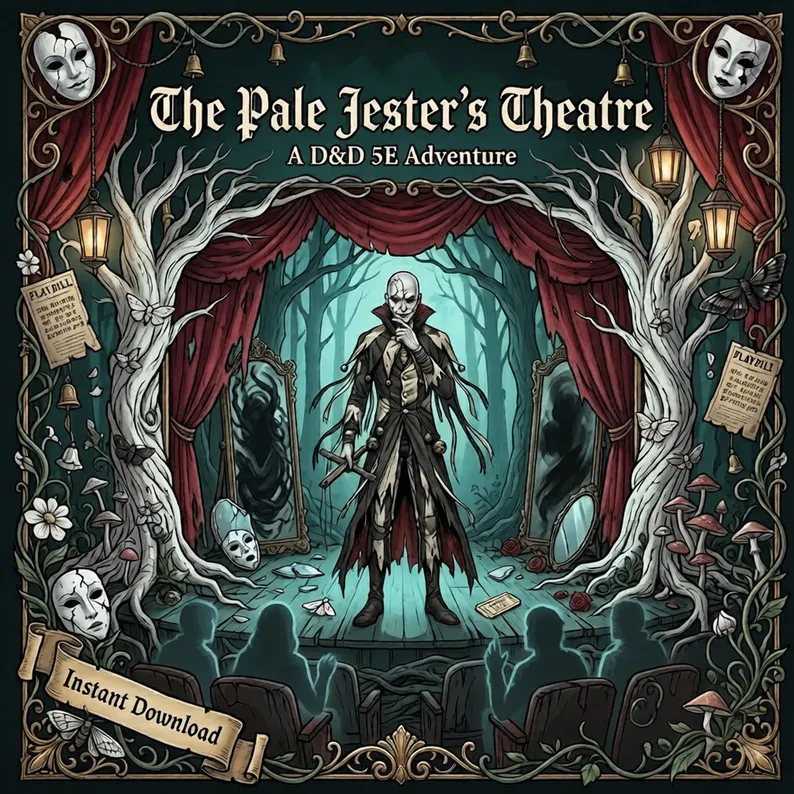
The Pale Jester’s Theatre
This scene is a one-room taste of how The Pale Jester’s Theatre works. In the full adventure, an Archfey stages illusions that make the party misread each other, tracked with Doubt and Trust tracks across a whole adventure instead of one dressing room. It is a 54-page levels 5–8 Feywild adventure with a DM Cheat Sheet, a printable DM tracker, player handouts, and built-in Session Zero and safety-tool guidance. It runs 3 to 8 hours depending on how many locations you use.