You do not need to teach a four-year-old initiative order, armor class, six ability scores, spell slots, and twenty pages of character options before they can pretend to be a knight.
For very young kids, roleplaying works best when the rules disappear behind the story. Give them a character they understand, a few simple choices, and a world that reacts immediately.
Keep the character sheet tiny
For ages 3–7, a character can be represented by a handful of things: a name, a picture, a few hearts, one or two strengths, and one special item. If a child can glance at the sheet and explain who their hero is, it is doing its job.
Instead of asking for a Dexterity saving throw, try: “Are you going to be quick, clever, strong, kind, or magical here?” You're not hiding math forever. You're just keeping the first few sessions about imagination and choice.
Make choices physical and visible
Young kids respond well to things they can point at, count, move, trace, or compare. Put three stones on the table. Show two paths. Draw a big bridge. Let them place a token on the answer. The more of the game that exists outside a paragraph of spoken description, the easier it is to stay engaged.
Make the math change the story
If the adventure includes counting or math, the answer should change the story. Counting three missing lanterns opens the gate. Matching equal groups calms a magical scale. Finding the number missing from a sequence reveals the forest path.
That is different from stopping the adventure to hand over a worksheet. The child is solving a problem because their hero needs the answer.
Good session length
For preschool and early elementary players, 20–45 focused minutes can be a complete session. Stop while they still want another scene. A story that takes an adult group one night can become three or four little family sessions.
Let failure get weirder, not over
Young players need room to make choices that go wrong, but "you fail, nothing happens" kills the momentum fast. Go for a consequence that creates a new situation instead: the bridge wobbles, the goblin grabs the wrong bag, everyone ends up covered in purple dust.
The story keeps moving, and the child gets another chance to act.
Let adults help without taking over
Parents naturally want to steer toward the correct answer. Give them a different job: play a companion, ask questions, celebrate ideas, or offer two options when the child is stuck. The young player should still be the person whose choice changes the scene.
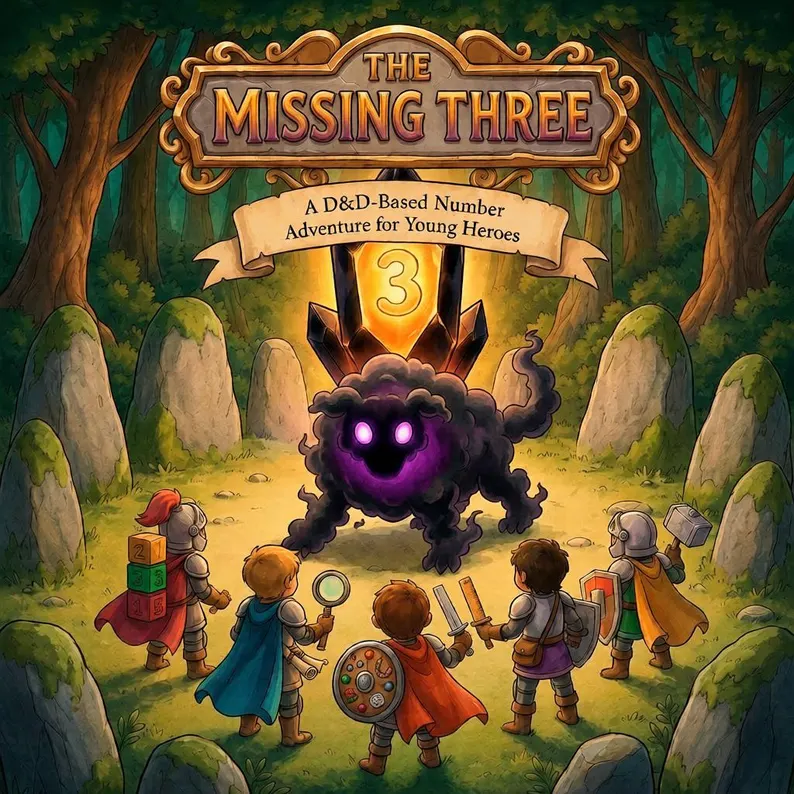
The Missing Three
A fantasy number adventure for ages 3–7 built around simple hearts, choices, teamwork, counting, and a story where numbers literally hold the world together.
View Chapter 1 on Etsy ↗A simple first-game formula
- Introduce a problem. Something's missing, mixed up, or in danger.
- Give two or three choices, never a blank "what do you do?" if the kid looks stuck.
- Work in one physical puzzle: counting, matching, comparing, tracing, moving something around.
- Throw in something silly or exciting. A goblin, a talking tree, a runaway cart, a dragon who's more grumpy than dangerous.
- End with a win they can actually see: the bridge fixes itself, the crystal lights up, the village cheers.
That's a real roleplaying game already. The complicated rules can show up years later, if the kid ever wants them.